

How did an affiliate turn $338 into $1,009 in one week, with a card game offer? The difference sat in the choice, and that choice can be repeated.
The offer was RummyCircle, in India, one of the open-numbers real cases behind this guide. Almost every beginner’s mistake is born before the first click, at the moment of choosing the offer.
Here you’ll learn to read the offer, work out what each lead (the sign-up the advertiser pays for) can cost, and check real cases.
Table of Contents
- 1 – Why the offer decides the profit in CPA
- 2 – What to look at in a CPA offer
- 3 – How much a lead pays in each CPA vertical
- 4 – The signs of a bad CPA offer
- 5 – The test math on a CPA offer
- 6 – Real CPA offer cases with numbers
- 7 – The right offer for each traffic source
- 8 – Where to find CPA offers and spy on competitors
- 9 – The final checklist before the first ad
- 10 – CPA offer FAQ
- 11 – The right CPA offer: the bottom line
Why the offer decides the profit in CPA
The offer is the proposal the advertiser publishes on the CPA network, with the paid action, the payout, and the rules. Whoever chooses badly is already losing money before the first ad.
The RummyCircle affiliate didn’t have a genius ad or a big budget, and still had the thing that matters: an offer with a light KPI, 5 deposits per 100 sign-ups, in a cheap country.
He spent $338 and collected $1,009 in 7 days. The return was 198% (Traffic Cardinal, 2022).
- Choosing by the headline payout, without looking at how many leads the advertiser approves
- Entering the offer everyone already runs, with the audience tired of the ad
- Testing without knowing what a lead can cost, and finding the loss at the end of the month
These mistakes repeat in almost every beginner’s report, and all of them come from the rush to skip this reading. The ad decides who clicks, and the offer decides who pays.
The AFF+ network paid $2.45 per install with sign-up, and most networks paid close to $1 for the same action. Reading everything to the end was all it took to find that gap.
The mid-priced ones are the dashboard’s hidden gem. They draw less competition, approve more, and don’t blow through the sales cap.
On RummyCircle, $338 became $1,009 in 7 days on the strength of the offer choice alone.
What to look at in a CPA offer
The offer’s lines decide your cash, and each one answers one of the affiliate’s money questions. In the Prostanorm Forte case, in Mexico, the cap was 150 leads a day and the approval sat at 32 in 100.
On an offer, the approval rate is the share of leads accepted, and trash is the slice of invalid leads. One makes no sense without the other when calculating profit.
The wait until the payout is called the hold, and the daily lead limit is the cap. The cookie is the window in which the click stays yours.
- Payout per action: what comes in per approved lead, and it only means anything next to the approval
- Approval rate: how many leads the advertiser pays for; there’s a dirty version and a clean one
- Trash: how many leads don’t count, from wrong data, duplicates, or dead phone numbers
- Hold: how many days the money stays locked, 7 to 30 depending on the vertical
- Cap: how many leads the advertiser buys per day, which sets the ceiling on scaling
- Cookie: for how many days the click is yours, because a conversion after the window pays nothing
- Allowed traffic: where the lead can come from, because a banned channel hands back rejected leads
Compare offers line by line, because the payout alone lies. The guide on how CPA works explains hold, approval, and caps in detail.
Dirty approval and clean approval
The manager quotes one approval, but the profit math uses another, and the difference between them is the trash. The example below comes from a media buyer screening test.
- Dirty: counts only the leads the advertiser got around to evaluating
- Clean: counts every lead sent, trash included, which is why it comes out lower
- Beginners guess a 50% to 55% approval; the real one for joint supplements in Tier 2 starts at 30% to 38% and only reaches 45% after the call center warms up (CPA Live, 2026)
- At a 50% approval, the $25 lead is really worth $12.50; with clicks at $0.50, the conversion needs 4% just to break even (CPA Live, 2026)
Always ask for the clean approval, and if the manager only has the dirty one, subtract 30 points, the average trash according to AddSet, in 2022. Without that number, the lead’s ceiling comes out wrong.
The cookie and the click’s window
The click has an expiration date, and the offer says how many days it lasts. A product people take time to decide on calls for a long cookie, 30 days or more.
- A purchase on day 5 with a 7-day cookie: the lead is yours
- A purchase after the window: nothing, no matter how much the click was yours
Cap: the ceiling that decides who scales
The cap says whether the test is worth anything. A new account gets a test cap, and its size changes everything.
- A real casino test: 20 to 30 first deposits (CPA Lenta, 2025)
- A 100-lead-a-day cap usually goes to teams with volume, and the solo affiliate gets a smaller limit
- The advertiser may not pay for the test, or freeze the continuation even after a good return
- Leads beyond what the call center can handle worsen everyone’s approval
Ask for the test cap and the path to raising the ceiling before spending. A network that warns you when the cap is running out keeps you from throwing traffic away.
The hidden target in the offer
Part of the offers demand, beyond the lead, an extra target called a KPI, which the advertiser enforces before paying.
Casino and betting also use a baseline, the minimum accumulated deposit that unlocks the lead. A soft target pays even below the agreed mark, and a rigid one hands the lead back unpaid.
- Rigid KPI: 30 in 100 sign-ups make a deposit, common in apps
- Light KPI: 5 in 100 sign-ups make a deposit, and the network pays even below that
- Baseline: the player accumulates a minimum deposit before the lead counts, in casino and betting
Extra fine print, like requiring warmed accounts or banning brand keywords, also makes the campaign more expensive. The contract sits on the advertiser’s side.
With a rigid target, the same traffic would have paid zero, and whoever skips that line delivers the traffic and gets the bill.
Compare the same offer across networks
The same campaign shows up on several networks at different payouts. The difference is each dashboard’s margin.
- The payout per action and the network’s margin
- The hold and auto-approval, common at networks where the advertiser prepays
- The minimum payout and the payment schedule
Getting paid less but sooner is sometimes worth more to whoever runs on thin cash. Auto-approval with no hold is worth more than an extra $10 on the offer.
How much a lead pays in each CPA vertical
The lead’s price moves with the vertical (the offer’s sector), with the paid action, and with the GEO (the audience’s country). In the Prostanorm Forte case, in Mexico, each confirmed order earned close to $18, according to CPA Lenta, in 2023.
| Vertical | Paid action | Range | Median |
|---|---|---|---|
| Nutra (health and beauty) | confirmed order | $20 to $80 | $40 |
| Betting and casino | first deposit | $25 to $100 | $50 |
| Dating | sign-up | $2 to $25 | $2 |
| Apps | install | $0.70 to $10 | $10 |
| E-commerce | order | $5 to $100 | $30 |
Rich countries run past these ranges: nutra above $100, betting near $250, and a finance app with an in-app action pays up to $85, while in dating the payout climbs with a confirmed sign-up and a rich country.
The numbers come from public offers and reports from 2019 to 2026. Finance stayed out: the payout swings too much with the action, from a cheap sign-up to an approved card above $100.
The same product changes price by country. Take a real casino with the same product and 4 prices.
| Country | Per deposit | Test cap |
|---|---|---|
| US, Canada, and Australia | $200 | 10 deposits |
| France and New Zealand | $150 | 20 deposits |
| Japan | $130 | 20 deposits |
| Russia | $40 | 20 deposits |
Choose the vertical by the size of your bankroll, because the biggest payout usually hides the hardest action, and a 2-field sign-up converts easily but pays little.
SustavPro, a joint supplement offer, ran in Armenia, Kazakhstan, and Uzbekistan with an audience 57 and older. The longer the funnel, the higher the payout and the lower the conversion, because a deposit takes the visitor’s trust.
What each vertical demands
The higher the payout, the harder the rules tend to be, and each vertical charges its price in red tape.
- Gambling and betting: minimum age, per-country licensing, and a short list of allowed traffic
- Nutra: high ceilings in emerging countries, with the creative (the ad itself) policed by the platforms
- Finance, jobs, and education: the whitehat block, with no ban risk
- E-commerce: the widest door, taking almost every traffic source
Seasonality and the click’s cost
The same offer changes price with the calendar, and the ad auction follows the season.
- Gardening and air conditioning sell in the summer
- Heaters sell in the winter
- Perfume and gifts sell over the year-end holidays
At the peak, the ad auction runs 3 to 5 times more expensive than in the off-season. At the turn of the year the opposite happens, and the creative that used to break even starts turning a profit, according to AFFY, in 2026. Check on Google Trends whether the vertical is climbing or falling, because a World Cup or an election floods the ad auction.
The signs of a bad CPA offer
A bad offer gives itself away before costing a dime in ads. A few patterns account for most of a beginner’s losses, and all of them show up before the test.
| Clean approval | What it means |
|---|---|
| 30 in 100 or more | sustains a paid campaign |
| 20 in 100 | only in push |
| 15 in 100 | instant veto |
| 10 in 100 or fewer | zero earnings |
A shallow approval
Always ask for the clean number and distrust the manager who only knows the dirty one, because a low approval tanks the campaign, even with the cheapest, prettiest ad. On El Patron, in Ecuador, the dirty approval was 38 in 100 and the clean one, 21 (Traffic Cardinal, 2023).
- At 15 approved leads in 100, nobody closes the math
- At 10 in 100 or fewer, the earnings are zero
The worn-out offer
A worn-out offer is one that dozens of affiliates already run in the same country. The audience gets tired of the repeated ad, and the approval drops along with the conversion.
- In the spy tool (the tool that shows competitors’ live ads, like AdHeart), a creative that ran 30 days and vanished means a spent offer
- An offer dead in Europe is reborn in India or Portugal, 2 lightly contested countries
- In paid search, an offer enters with at least 3,000 monthly searches for the brand (Cpagram, 2021)
The wear-out changes from country to country. It’s only worth entering if the advertiser is willing to relaunch the campaign with a fresh face.
The price too good to be true
When an expensive product shows up at a small price, the seller only tells the rest on the confirmation call, the customer bails right there, and the lead becomes a rejection.
- A mandatory kit revealed only on the call
- A subscription buried in the purchase
- An aggressive upsell at confirmation
In the United States and Europe, regulators treat that trap as an abusive practice. Stay away from easy-money ads: they attract people who only want the freebie, and the lead becomes a rejection.
The promise of an eternal revenue split
There’s a model that pays a slice of the customer’s spend, RevShare (revenue share). The model exists and pays at serious networks, and the scam lives in the exaggerated promise. For a first campaign, prefer a fixed payout per action, the simplest format to audit.
- A lifetime slice of 70 in 100 for the affiliate doesn’t survive the advertiser’s math (AddSet, 2022)
- A revenue split is hard to measure in a short test
The cut after the raise
A bad-faith network grants a payout raise and soon after makes leads vanish from the report. That silent cut has a name in the niche, and the manager never brings it up.
Shave is leads disappearing from the report so the network pays less, noticed only weeks later, according to Cpagram, in 2023. Only a written agreement with the network protects the affiliate.
- A maximum cut of 10 to 20 in 100 deposits in the typical agreement
- Full payment outside of fraud, when the agreement is good (Traffic Cardinal, 2026)
- With no agreement at the start, the dispute is word against word
The test math on a CPA offer
After the choice, the small test decides, with 1 to 3 creatives and a short budget. Earnings per click (EPC), the conversion rate (CR), and the return (ROI) turn that test into a decision. On an offer, the EPC is the average earnings per click, and CR is the click-to-lead conversion rate.
- EPC (earnings per click): what comes in, on average, per click on the offer; ask for your source’s EPC instead of the overall average
- CR (conversion rate): how many clicks become leads; on a modest payout, a high CR fattens the month
- ROI (return on spend): what came back over what went out; the yardstick is in the table
| Test profit | Decision | Source |
|---|---|---|
| up to 10% | comfortable cash only | CPA Mafia (2024) |
| 20% to 30% | clears the way to scale | Traffic Ultras (2025) |
| above 100% | scale now | CPA Mafia (2024) |
Below 20%, scaling is for whoever has comfortable cash, and a 20% to 30% profit in testing already clears the way to scale (Traffic Ultras, 2025).
The lead’s ceiling and the click’s ceiling
Before raising the budget, find out what each lead can cost. On El Patron, the payout per lead sat at $12.35 across the 4 months, and the affiliate set his bid from there.
| Ceiling | Formula | Example | Result |
|---|---|---|---|
| Per lead | payout × clean approval | $22 × 20% | $4.40 |
| Per click | ceiling × conversion | $4.40 × 2% | $0.09 |
Pay at most that ceiling per click. If the click costs more than that, fix the page or switch the source, and switch products last.
The right size for the test
A small test isn’t a blind test, but 2 leads tell no story at all. Wait for at least 10 leads.
- Wait for enough clicks to generate at least 10 leads before judging
- Give the ad set at least 10 times the payout per action. Rewardis set aside 10 to 15 lead payouts (Cpagram, 2024)
- In a rich country, $500 vanishes with no answer, and the realistic budget passes $1,000 (CPA Lenta, 2024)
- On ACE, a male enhancement offer in Thailand, 3 of the 5 creatives brought nearly all the revenue, and the other 2 went out (CPA.RIP, 2019)
- Check in the
postback(the automatic conversion notice) that every lead carries theSubID(the source tag). Without it, you don’t know which ad paid
On RummyCircle, $338 bought 169,206 clicks, and only 412 became sign-ups with an install. On day one, the affiliate shut off the low-conversion ads, even the profitable ones.
Shut off the ad set whose lead passes the ceiling before spending half the budget. Placements and channels with a low CTR go out in the same cut.
Real CPA offer cases with numbers
Public cases from the niche show how the offer choice becomes real cash. All of them open up spend, revenue, and approval, with each report’s year.
| Offer and country | Spend | Revenue | ROI | Source |
|---|---|---|---|---|
| SustavPro, joint supplement, Central Asia | $51,900 | $106,796 | 105% | Pirate CPA (2024) |
| Prostanorm Forte, nutra, Mexico | $5,199 | $9,414 | 81% | CPA Lenta (2023) |
| Clean Forte, detox, Mexico | $13,495 | $18,372 | 36% | ProTraffic (2023) |
| RummyCircle, card game, India | $338 | $1,009 | 198% | Traffic Cardinal (2022) |
| Rewardis, sweepstakes, social media | $8,443 | $15,480 | 83% | Cpagram (2024) |
| ACE, male enhancement, Thailand, push | $2,412 | $5,688 | 136% | CPA.RIP (2019) |
| Aviator casino, contested country | $14,184 | $41,370 | 191% | Traffic Ultras (2025) |
| El Patron, male enhancement, Ecuador | not disclosed | $30,654 | not disclosed | Traffic Cardinal (2023) |
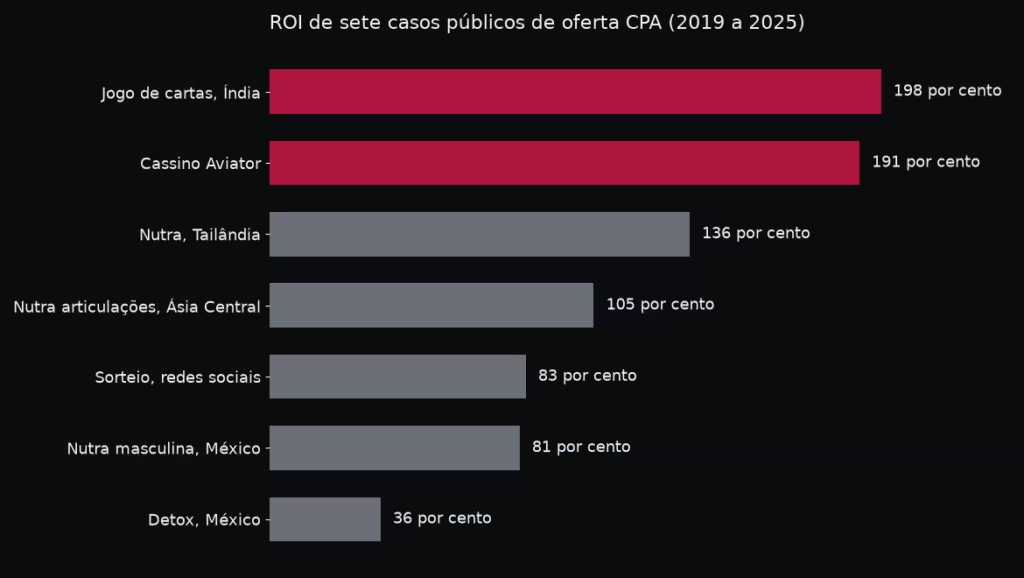
Almost every case turned a profit, and the worst one returned 36% over spend. None of them passed $52,000 in investment (ProTraffic, 2023).
- In the nutra cases, the real approval landed between 21 and 32 in 100 leads, far from the 50 promised on the offer; on El Patron, it was 4 months at a clean approval of 21 in 100
- The smallest budget, $338, profited $671 in 7 days on a $0.002 bid per click
- The market called the Aviator offer worn out, and it nearly tripled the investment in a contested country (Traffic Ultras, 2025)
The worn-out label applies to one country and one angle, and the product as a whole may still be alive elsewhere. Whoever pays for ads without validating can spend the same thousands and collect zero, and with organic traffic you risk time instead of money.
The right offer for each traffic source
A product good on paper earns zero at the wrong source, and the dashboard won’t warn you. The match between the audience’s origin and the offer’s type decides the conversion before the creative does.
- Blogs and search: long-research offers, like finance, subscriptions, and courses
- Paid social: nutra, dating, and apps, which live off impulse and imagery
- Cheap push: betting and sweepstakes, which can survive a 20-in-100 approval
- Paid social in a cheap country: on Rewardis, Nigeria delivered 10,332 conversions out of 115,424 leads through Facebook
- Your own group: offers on the group’s topic, without forcing a foreign product
- E-commerce: takes almost every source, from search to push
ACE ran on push notifications in Thailand, with 6 pre-landers and 4 pages in the test, according to CPA.RIP, in 2019. The affiliate shut off the pages that didn’t convert in the very first test.
The offer lists the accepted traffic, and the advertiser vetoes channels where it advertises itself. Whoever watches sports videos clicks on betting, and whoever reads a finance blog clicks on cards.
- In paid search, the profit usually comes from 20 to 30 in every 100 keywords tested (CPA Lenta, 2025)
- Whoever sends 5 leads a day fits any cap, and whoever sends 100 only fits a network that can handle the volume
Start with a single source and offers from a single vertical. Tell the manager your real volume, because the right choice for 5 leads a day is a different one for 100.
Where to find CPA offers and spy on competitors
Offers live on CPA network dashboards and in advertisers’ direct programs. The network pays a little less and gives back variety, support, and payment guarantees, while direct pays full and demands volume.
The cheapest shortcut is spying on whoever already spends. The spy tool shows the ad, the country, and the source of every campaign competitors are running.
- AdHeart, Anstrex, and SpyOver cover push, native, and social media
- Meta’s ad library does the same for free, with each piece’s start date and copy
- A creative live for more than 30 days is a clue to a paying campaign, because nobody keeps an ad running at a loss for a month
Copying a competitor’s creative is a rookie mistake. The reports from 2023 to 2026 repeat the warning.
What to ask the manager
The network’s manager rounds out the service for free. Tell them your source and your volume, and ask for the offers that run best on that profile. Show up with numbers, because a vague question gets a canned list, and naming the source and the volume gets the hot offer.
- The last few weeks’ clean approval, with the invalid leads counted, campaign by campaign
- My source’s EPC on this offer over the last 30 days, instead of the overall average
- The test cap for a new account, which in casino runs 10 to 30 deposits, and the path to raising it
- The product’s minimum deposit and the payment methods accepted in the country
- The offers that just relaunched, before the line grows
- The creatives and pages with the best track record on this offer, kept by the network
The final checklist before the first ad
The whole choice fits in a short list of checks, in this order. Run the sequence start to finish, write down each item’s result, and cut without mercy any offer that fails at any point, before spending on ads.
- Pick a vertical and a country that match your traffic source
- Read the whole offer: payout, approval, trash, hold, cap, cookie, and rules
- Convert the dirty approval into the clean one before any math
- Spy on competitors in the spy tool before creating any ad
- Ask the manager for your source’s EPC, the cap, and the hot offers
- Check the KPI, the baseline, and the offer’s season
- Run the test with 1 to 3 creatives and a budget of at least 10 times the payout per action
- Close the math on CR, EPC, ROI, and the lead’s and click’s ceilings
- Scale only the offer that showed numbers and kill the rest without mercy
Before blaming the offer
A stalled campaign can have a cause beyond the offer. The chain has several links, and each one fails in its own way.
- Rare clicks, below 1 in 100 impressions, point to the creative or the targeting
- A page that scares off more than 7 in 10 visitors betrays a broken promise or a slow load
- Broken tracking, delayed stats, and a cap closed without notice are the network’s failures, and the offer is still good
Put the offer on trial last, because switching offers with a broken creative is throwing away a paid test. A targeting cut often solves it without changing anything: on Clean Forte, in Mexico, the manager asked for an older audience, and the approval climbed to 32 to 40 in 100 (ProTraffic, 2023).
CPA offer FAQ
What is an offer in CPA?
It’s the request the advertiser publishes on the network’s dashboard. It carries the paid action, the payout, the hold, the cap, and the traffic rules.
What’s a good approval rate on an offer?
A clean approval of 30 in 100 leads or more sustains a paid campaign. One that approves 15 in 100 or fewer deserves an instant veto.
How do I convert a dirty approval into a clean one?
The dirty one looks only at the leads the advertiser got around to examining. The clean one divides by the leads sent, trash included, and it’s the number that works for calculating profit.
What is a test cap?
It’s the number of leads the advertiser buys from a new account before unlocking more. In casino, 20 to 30 deposits make a real test, and a smaller one shows nothing.
What is a worn-out offer?
It’s one that plenty of people have been running in the same country for months. The sign shows up in the spy tool, with an ad that ran for weeks and then vanished.
What ROI justifies scaling a campaign?
A 20% to 30% return in testing already authorizes scaling. With comfortable cash, 10% sustains it, and above 100% the order is to scale now (CPA Mafia, 2024).
What is trash on an offer?
It’s the slice of invalid leads, with wrong data, duplicates, or dead phone numbers. Those orders pay nothing and sit around 30 in 100.
Do I need a spy tool to choose an offer?
It helps a lot, and part of them are free. AdHeart, Anstrex, and Meta’s ad library show what competitors are running right now.
Is the network’s highest-paying offer worth taking?
Rarely, because a high payout comes with a hard action and a short cap. The mid-priced one with an easy conversion usually earns more over the whole month.
How do I know whether the offer or the ad is to blame?
Rare clicks point to the creative. A page that scares off 7 in 10 visitors points to the promise, and only after those checks is it worth switching products.
The right CPA offer: the bottom line
The right choice runs through the full offer, with payout, clean approval, trash, hold, cap, cookie, and rules, in that order. Every line is worth money, and the dashboard reads none of it for you.
- A shallow approval
- A worn-out market
- A price too good to be true
- An eternal revenue split
- The cut after the raise
These vetoes show up before any test. The small test closes the choice with EPC, CR, ROI, and the lead’s and click’s ceilings.
Scale what showed numbers and kill the rest early, as on SustavPro, where 3 days of climbing clicks meant swapping the creative.
The other guides in this series continue the path. The ActionPay review shows a real offer read line by line.
How we sourced this post
The numbers come from public offers and case reports in the niche, checked in August 2026. Each offer’s terms come from the networks’ own materials.
Commission, hold, and approval rates change without notice, and the catalog turns over every week. Check the offer in the dashboard before putting money on media.
Our fact-checking process is on the About CPA RAW page, and the other guides in this series follow the same method.
Spotted an outdated number? Let us know through the contact page.
This post is informational and not financial advice. Media buying carries risk: you pay for the traffic before you know whether it converts.
Leave a Comment