

Which metric decides the profit: the conversion rate (CR), earnings per click (EPC), or return on spend (ROI)? Each one answers a different question about the same campaign.
In Austria, an affiliate spent $10,016 on ads and got $24,187 back. The network approved fewer than half the leads (the actions the offer pays for), and the profit came from the right price per click.
Here you’ll learn the math behind each metric, the click ceiling, and how to read the funnel stage by stage.
Table of Contents
- 1 – What CR, EPC and ROI measure in CPA
- 2 – How to calculate EPC and the click ceiling
- 3 – What conversion rate is good at each stage
- 4 – How much ROI a CPA campaign needs
- 5 – Why the higher-paying offer earns less
- 6 – How to read CR, EPC and ROI together before scaling
- 7 – Real CR, EPC and ROI cases in CPA
- 8 – The reading mistakes that hide losses in CPA
- 9 – The metrics checklist before raising the budget
- 10 – CR, EPC and ROI in CPA FAQ
- 11 – CR, EPC and ROI in CPA: the bottom line
What CR, EPC and ROI measure in CPA
The conversion rate (CR) is the share of clicks that becomes a paid action, and earnings per click (EPC) is the revenue each click brings in. Return on spend (ROI) is profit divided by spend, as a percentage.
| Metric | Math | Example | Source |
|---|---|---|---|
| Conversion rate (CR) | actions ÷ clicks | 2% | Traffic Ultras (2024) |
| Earnings per click (EPC) | revenue ÷ clicks | $0.25 | Traffic Ultras (2024) |
| Return on spend (ROI) | profit ÷ spend | 150% | Affy (2025) |
| Return on ad spend (ROAS) | revenue ÷ spend | 300% | Cpagram (2022) |
The table’s examples come from simple math: 20 actions over 1,000 clicks give a 2% conversion rate, and $500 over 2,000 clicks gives $0.25 per click. With $100 spent, $250 in revenue gives a 150% return, and $300 gives a 300% ROAS.
The affiliate in Austria, for example, had 1,011 leads, and the network approved 440. The rate that matters is the approved-lead rate, because the network pays only for the action it approves.
- Google Ads‘ conversion rate uses the same math: conversions divided by ad interactions
- The rate the network shows combines every affiliate on the offer, and yours can land far from it
- The offer’s EPC is the sum of every affiliate (ProTraffic, 2019)
- With 5 affiliates at 1 ruble and 2 at 38 rubles, the dashboard shows 11.5 rubles (ProTraffic, 2019)
- The approval rate (the share of leads the network approves) changes by country and by traffic
- The return uses approved revenue, and money on hold (the wait until the payout) isn’t revenue yet
- A return equal to the spend means the money doubled, and a return below zero is a loss (Cpagram, 2022)
Is $0.25 per click good or bad? It depends on the cost of the click: above it, the campaign pays, and below it, the campaign loses.
How to calculate EPC and the click ceiling
Earnings per click come from the payout per action, the share of leads the network approves, and the page’s conversion rate. Multiply the 3 and you have the ceiling on what you can pay for a click without losing money.
The click-ceiling math on a weight-loss offer
Write down the payout per approved lead, your batch’s approval rate, and the page’s rate. The click ceiling comes from multiplying them, and the real EPC lands below it. The math below starts from $22 per lead (Cpagram, 2024).
| Step | Input | Math | Result |
|---|---|---|---|
| Payout per approved lead | $22 | from the offer | $22 |
| Approval rate (the approved share) | 20% | $22 × 0.20 | $4.40 per lead |
| Page’s conversion rate | 1.92% | $4.40 × 0.0192 | $0.0845 per click |
| Break-even click ceiling | $0.0845 | equal to the EPC | $0.0845 |
| Click that doubles the money | half the ceiling | $0.0845 ÷ 2 | $0.042 |
| Or doubled conversion | 3.84% | 1.92% × 2 | same return |
With a $0.10 bid on that offer, every visit loses money before the campaign even starts (Cpagram, 2024).
The way out is lowering the bid, swapping the page, or swapping the offer.
Redo the math with your traffic’s real approval rate, because the dashboard shows the offer’s combined number. In Poland, an affiliate sent 362 leads, 179 came out valid, and the network approved half of them.
How far the EPC needs to clear the bid
When the EPC only ties with the bid, it’s still a loss, because part of the visits gets lost on the way to the page. The margin has to exist before you raise the budget.
| Situation | EPC | Bid | Source |
|---|---|---|---|
| Teaser network, 3,000 clicks | 2 rubles | 1 ruble | ProTraffic (2019) |
| Same network, tie | 1 ruble | 1 ruble | ProTraffic (2019) |
| Same network, half the earnings | 0.5 ruble | 1 ruble | ProTraffic (2019) |
| Microloans, top offer | 30 rubles | 40 rubles | Cpagram (2026) |
| Credit card | 11 rubles | varies | Traffic Cardinal (2024) |
| Dating via smartlink | $0.35 | below the EPC | Conversion.im (2023) |
On the teaser network, an EPC above the bid doubled the money, the tie gave zero on paper and a loss in practice, and an EPC at half lost half the spend. In microloans, the top offer lost money even with a high payout per lead, and on credit cards the high payout per issued card pays little per click.
- An EPC of 2 to 3 times the bid is a good result (ProTraffic, 2019)
- With 1,000 to 2,000 clicks you can already tell whether your EPC is normal (ProTraffic, 2019)
- In push (the on-screen notification) for betting in India, an EPC above $0.15 already calls for a bigger budget (Traffic Cardinal, 2026)
What conversion rate is good at each stage
A campaign has several conversion rates, one per stage: click to sign-up, sign-up to deposit, and lead to approved lead. The good rate changes by stage and by product, and the network usually shows the last one.
| Stage | Rate seen in the niche | Where | Source |
|---|---|---|---|
| Click to install, web app | 5% to 6% | Bangladesh, casino | Partnerkin (2025) |
| Click to sign-up, betting | 20% to 30% | one network’s standard | Affy (2025) |
| Sign-up to deposit, betting | 5% to 10% | same network | Affy (2025) |
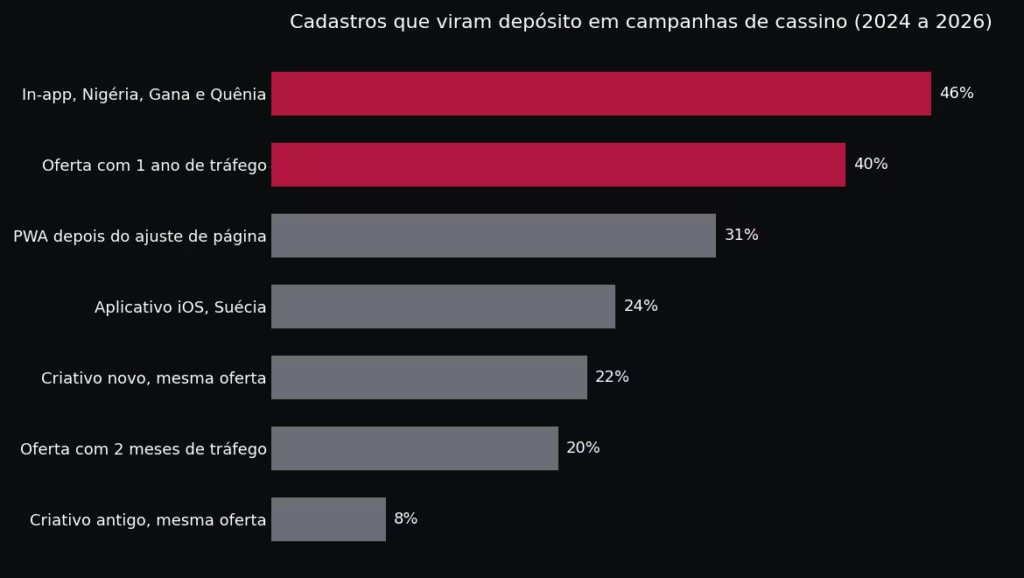
| Sign-up to deposit, in-app | 45% to 47% | 3 African countries | CPA Mafia (2026) |
| Sign-up to deposit, new offer | 20% | offer 2 months old | Pirate CPA (2024) |
| Sign-up to deposit, mature offer | 40% | offer 1 year old | Pirate CPA (2024) |
| Lead to approved lead, betting | 30% to 60% | several countries | Cpagram (2026) |
| Click to lead, microloans | 10% to 15% | Russia | Cpagram (2026) |
| Page to lead, weight loss on Facebook | at least 2% | nutra test | Cpagram (2024) |
In Bangladesh, for example, the web app’s install rate sat at 5% to 6%, against the country’s normal 10% to 14% (Partnerkin, 2025).
No bid could pay for the campaign with that intake, and the team went looking for the flaw on the page before touching the ad.
- A page that loads slowly on phones tanks the click-to-sign-up stage, and it’s the first place to look
- Local payment on the page, like Pix in Brazil, lifts the sign-up-to-deposit stage (Pirate CPA, 2026)
- A creative (the ad itself) that promises something else tanks the sign-up-to-deposit stage: the player signs up and vanishes (Cpagram, 2024)
- An app with 10 casinos on a single page lifted the sign-up-to-deposit conversion by 25% to 40% (Pirate CPA, 2025)
- In Romania, cutting the overnight hours and lowering the bid on sources with no sign-ups doubled the deposits, from 42 to 93 (AffTrends, 2025)
The good rate is the one that closes the ceiling math with room to spare. A high rate with a high bid loses to an ordinary rate with a low bid.
How much ROI a CPA campaign needs
The return a campaign needs depends on its phase and its volume. In testing, the niche accepts a low return, and at scale the same number becomes a loss because the error grows with the budget.
| Phase or product | Return on spend | Source |
|---|---|---|
| Offer test | 20% to 40% | Cpagram (2023) |
| Scale | 60% or more | Cpagram (2023) |
| Big, stable volume | 30% | Cpagram (2023) |
| TeslaTraff team | 80% or more | Partnerkin (2023) |
| Nutra (supplements and creams) at volume | 25% to 30% | Cpagram (2024) |
| Crypto | 100% or more | Cpagram (2024) |
| Adult | 20% to 30% | Conversion.im (2019) |
| Web app (PWA) in casino | 70% | CPA Lenta (2023) |
| Tight market | 15% | Cpagram (2026) |
A PWA is the web app that installs without going through an app store. A builder like EpicPWA puts one together with a free plan and paid plans from $39.
In testing, 20% to 40% is acceptable and it’s not yet time to raise the budget. At scale, the target is 100%, and a team running big volume calls a stable 30% very good. In a tight market, 15% became the norm in 2026.
A return equal to the spend means every $1 spent came back as $2, and a negative return is money lost. The math with gross revenue forgets the cost of the card and the accounts, and the real return sits below the dashboard’s number.
- Virtual card fees eat between 1% and 14% of the budget, depending on the service (Cpagram, 2023)
- A total fee of 0.4% against 5% to 13% at other services lifted the return by 14% on a $10,000 spend (Cpagram, 2023)
- Every declined transaction costs $0.50 on some cards, and that can take 5% to 10% of the budget (Cpagram, 2023)
- Cutting 5% off the card’s cost lifts the profit by more than 20% without touching the ad (Cpagram, 2023)
- Daily cleanup of bad sources lifts the return by 10% to 20% (Cpagram, 2023)
The affiliate lives off a thin slice of the money moving through the offers, and that slice only exists with the return above the cost of the money sitting idle.
Why the higher-paying offer earns less
The payout per action is the offer’s most visible number and the one that says the least about profit. What goes into the math is the payout multiplied by the approval rate and the page’s conversion rate.
- Offer A: $37 per lead with a 35% approval earns $12,950 over 1,000 leads (Cpagram, 2023)
- Offer B: $30 per lead with a 55% approval earns $16,500 over the same 1,000 leads (Cpagram, 2023)
- Gap on the same batch: $3,550 in favor of the lower-priced offer (Cpagram, 2023)
The approval rate is the slice of leads the network approves, and it weighs more than the sticker price. A network that approves little hands your expensive traffic back as rejected leads.
- In Ukraine, the network raised the lead from $15 to $19 when the affiliate promised 20 leads a day (CPA Live, 2024)
- The same offer at another network started at $19, with a free product on the page and a low approval (CPA Live, 2024)
- In microloans, the repeat customer pays little or nothing, and filtering that customer lifted the EPC by 40% (Cpagram, 2025)
- The same filter took one affiliate’s return to 124% and doubled the revenue on the same traffic (Pirate CPA, 2026)
- If the EPC sits below 10% of the payout per action, the offer is weak for your traffic (Traffic Ultras, 2025)
- A top offer approving around 13 in 100 leads earns little even with a high conversion (Cpagram, 2026)
Before switching offers for the bigger payout, compare the 2 EPCs with your own traffic. The sticker price lies, and the approval rate decides.
How to read CR, EPC and ROI together before scaling
The 3 metrics tell the same story from different angles, and reading them together shows where the campaign leaks. Each pair that falls out of line points to a spot in the campaign, and the fix starts there.
The media test with $1,000 in spend
A media buyer screening test gives spend, clicks, leads, approval, and payout per lead, and asks for the return. The math shows why the approval rate decides the result. The test starts with $1,000 in spend and 500 clicks, and comes from CPA Live (2026).
| Step | Math | Result |
|---|---|---|
| Bid | $1,000 ÷ 500 clicks | $2 per click |
| Conversion rate | 50 leads ÷ 500 clicks | 10% |
| Approved leads | 50 × 40% approval | 20 leads |
| Revenue | 20 × $35 | $700 |
| EPC | $700 ÷ 500 | $1.40 |
| Return on spend | (700 minus 1,000) ÷ 1,000 | −30% |
With a $1.40 EPC and a $2 bid, the loss shows up before the month closes. Raising the approval to 6 in 10 leads would flip the campaign, and that’s the right question for the manager.
The pairs that point to the leak
When 2 metrics don’t line up, the pair shows where to look first. The interview question for affiliate managers is the same one the affiliate asks every morning.
- High conversion with a low EPC: the approval is low or the payout per action is low, so check the real approval and the payout (Cpagram, 2026)
- High EPC with a low return: the bid is high, so lower the bid or switch the source (Cpagram, 2026)
- A conversion of 8 in 100 with $0.40 earned per click: the problem is the page or the traffic, and that’s the interview question for affiliate managers (CPA Live, 2026)
- Plenty of clicks and few conversions: the page or the offer fell out of line with what the ad promised, so swap the page and revisit the promise (Cpagram, 2025)
- Few clicks with a high conversion: it’s a good source with little volume, so raise the bid or the budget on it (Cpagram, 2025)
- High sign-ups and low deposits: the ad promises what the player never finds, so align the ad with the page (Cpagram, 2024)
- The return drops on the same offer: it could be fraud, the wrong audience, a cut payout, or the source’s algorithm, so look at the source before the ad
In Romania, the affiliate waited on 4 weeks of data before cutting any source, because some weak sources took time to convert, according to AffTrends, in 2025. Cutting in the first week would have thrown away the following week’s deposits.
Real CR, EPC and ROI cases in CPA
The cases cover nutra, casino, and microloans across different countries and sources. Each row lists the spend, the revenue, and the final return, and the list below says what decided each one.
| Case | Spend | Revenue | Return | Source |
|---|---|---|---|---|
| Joint supplement, Austria, Facebook | $10,016 | $24,187 | 141% | CPA Mafia (2025) |
| Weight loss, Poland, Facebook | $1,331 | $2,457 | 84% | Cpagram (2024) |
| Blood pressure, Germany, Google Ads | $410 | $690 | 69% | CPA Live (2025) |
| Casino, Argentina, crash game | $279,325 | $465,534 | 67% | Cpagram (2025) |
| Microloans, Russia, Yandex | 641,000 rubles | 373,000 rubles | −41% → 56.52% | Cpagram (2023) |
| Weight loss, Ukraine, Google Ads | $879 | $1,043 | 19% | CPA Live (2024) |
| In-app betting, Africa | not disclosed | not disclosed | positive | CPA Mafia (2026) |
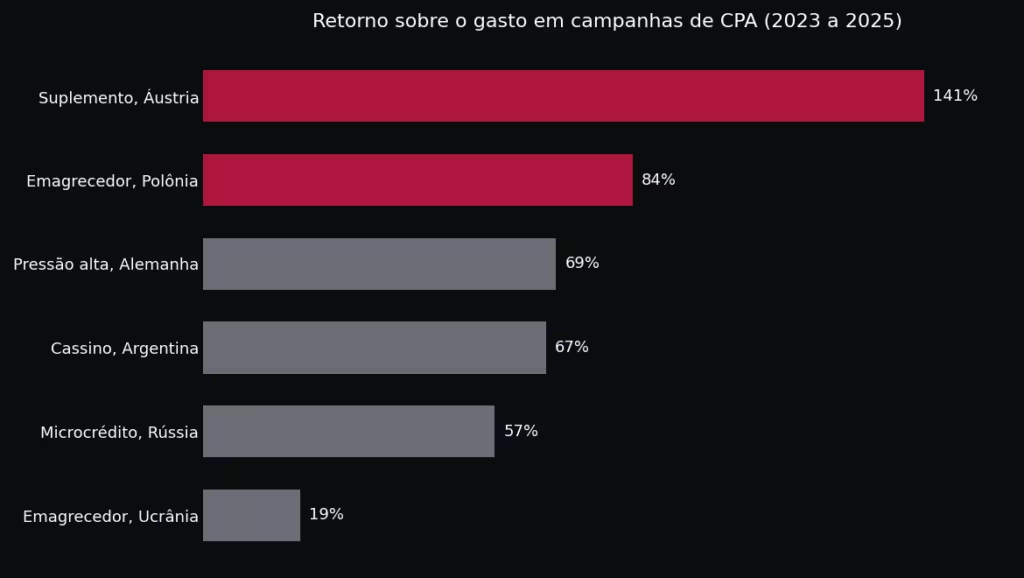
None of the cases won on the offer’s payout. All of them won at the stage the metric pointed to: the approval in Austria and Poland, the deposit in Argentina, the filter in Russia.
- In Austria, a 43.52% approval over 1,011 leads decided it, and the supplement approved better on the plain page, with no medical pre-lander
- In Poland, the approval was 25% of the total with leads at $3; in Germany, a 50% approval with leads at €24
- In Argentina, the deposit’s cost sat at $10.80 against $13 or more in the market, because the game opened in under 2 seconds on slow internet
- In Russia, the return went from −41% in month 1 to 56.52% in month 4 after cleaning keywords, cutting regions, and dropping the low-EPC offers (Cpagram, 2023)
- In Ukraine, leads landed between $2.50 and $7; in Nigeria, Ghana, and Kenya, 46 in 100 sign-ups became deposits
The reading mistakes that hide losses in CPA
The most common loss comes from a metric read alone, or read in the wrong place. The network’s dashboard, the tracker, and the ad manager show different numbers for the same campaign.
- Measuring sign-up-to-deposit in the tracker: a 1-year-old offer’s 40% rate carries deposits from old traffic, and a new offer shows 20% (Pirate CPA, 2024)
- Demanding the return within 30 days in betting: the profit lands in the following weeks, and an early cut kills the combination (Pirate CPA, 2024)
- Confusing ROAS with return: a 200% ROAS becomes a loss once the traffic’s cost enters the math (CPA Club, 2025)
- Comparing your rate against the offer’s on the dashboard: the dashboard combines every affiliate, and yours lands far from it (Traffic Ultras, 2024)
- Ignoring the repeat customer in microloans: the same traffic earned 2 times more after the filter (Pirate CPA, 2026)
- Counting money on hold as revenue: the hold can still turn into a rejected lead, and the return drops after the reconciliation
- Promising what the page doesn’t deliver: the click rate goes up and the approval goes down
In nutra, the conversion rate fell from 5 to 1 in 100 clicks in some countries, according to Partnerkin, in 2024. Leads in Latin America went from $2 to $5, and whoever read only the sticker price saw the loss late.
The metrics checklist before raising the budget
The 3 metrics read in a short sequence, and the order matters. Run the sequence with your real approval and costs, and raise the budget when the return clears the phase’s floor.
- Write down the payout per action, your batch’s real approval, and the page’s conversion rate
- Multiply the 3 and write down the click ceiling
- Compare the ceiling against the real bid at the source, and cut the source that passes it
- Check the EPC with at least 300 clicks before any decision
- Read the conversion rate stage by stage and find the one below the country’s normal
- Close the return with approved revenue and the card’s fees, and compare it against the phase’s floor
- Ask the manager for the last 30 days’ approval and the cap (the daily lead limit) before scaling
- A return above 60% in testing is the signal to open the guide on how to scale the campaign (Cpagram, 2023)
Before blaming the metric
A falling return on the same offer isn’t always the campaign. Before cutting, look at what changed outside it.
- The network lowered the payout or swapped the offer’s page
- The source changed its algorithm, like Instagram‘s new rules in 2025
- One source got nothing but bot traffic: plenty of clicks and no actions
- The tracking broke, and the
postback(the automatic conversion notice) stopped arriving with theSubID(the source tag) - Demand for the product fell in the country, and Google Trends shows the drop before the dashboard does
When 2 of these failures show up together, the campaign goes back to testing. Any one of them alone gets solved without touching the budget.
CR, EPC and ROI in CPA FAQ
What is CR in CPA?
The conversion rate (CR) shows how many clicks became the action the offer pays for. The math divides actions by clicks, and the number you see on the dashboard is everyone’s combined.
What is EPC and how do you calculate it?
Earnings per click (EPC) is revenue divided by clicks, and $500 in revenue over 2,000 clicks is the whole math. The result of $0.25 per click is what each visitor earned you, according to Traffic Ultras, in 2024.
What is ROI and what’s the math?
Return on spend (ROI) is revenue minus spend, divided by spend. With $100 spent and $250 in revenue, the profit is 1.5 times the spend, according to Affy, in 2025.
What’s a good ROI in CPA?
In testing, a return of 20 in 100 already works, and scaling calls for 60 in 100. A team running big volume calls a stable 30 in 100 very good, according to Cpagram, in 2023.
How do I know whether the problem is the page or the traffic?
A low conversion rate with plenty of clicks points to the page or to an offer out of line with what the ad promised. Few clicks with a high rate point to the source, and the move is to buy more of it.
Why can a higher-paying offer earn less?
Because the network pays for the approved action, and the approval rate weighs more than the sticker price. Over 1,000 leads, the lower-priced offer with the higher approval earned $3,550 more, according to Cpagram, in 2023.
How many clicks do I need before deciding?
At least 300 clicks per combination in paid ads, and 100 clicks per ad on Google Ads. In nutra on Facebook, the floor is 20 to 30 leads before cutting or scaling.
Is ROAS the same thing as ROI?
ROAS divides revenue by ad spend and ignores the cost of the product and the accounts. Return on spend subtracts what went out before dividing, and the number always comes out lower than ROAS.
Where do I see an offer’s CR and EPC?
On the network’s dashboard, on the offer’s page, next to the payout per action. The dashboard combines every affiliate running the offer, and your traffic may earn a different number.
What tanks the return on the same offer?
Click fraud, the wrong audience, a payout cut by the network, and a change in the source’s algorithm, according to Affy, in 2025. Each one shows up as the cost per lead climbing with the ad unchanged.
CR, EPC and ROI in CPA: the bottom line
The conversion rate says whether the click becomes an action, earnings per click say whether the action pays for the click, and the return closes the math. The 3 read together, with your real approval and bid.
- Work out the click ceiling before buying traffic
- Compare offers by EPC with your own traffic
- Read the conversion rate stage by stage and fix the weakest one
- Close the return with approved revenue and the card’s fees
- Wait for the click floor before cutting or scaling
The other guides in this series show how to choose the offer and how to scale the campaign with these numbers in hand.
On CPA Live’s $1,000 test, a 40% approval turned into a −30% return.
How we sourced this post
The numbers come from public offers and case reports in the niche, checked in August 2026. Each offer’s terms come from the networks’ own materials.
Commission, hold, and approval rates change without notice, and the catalog turns over every week. Check the offer in the dashboard before putting money on media.
Our fact-checking process is on the About CPA RAW page, and the other guides in this series follow the same method.
Spotted an outdated number? Let us know through the contact page.
This post is informational and not financial advice. Media buying carries risk: you pay for the traffic before you know whether it converts.


Leave a Comment