

From 200 to 2,000 conversions a day with the same app: what changed? Format, page, and creative (the ad itself), one at a time, with the offer that was already paying.
Scaling is the moment a campaign stops being a test and becomes a cash machine. It’s also when the most money gets lost, because the $50 mistake in testing becomes the $5,000 mistake at scale.
Here you’ll learn when to raise the budget, how much to raise per day, when to duplicate, and when to swap the creative.
Table of Contents
- 1 – When a CPA campaign is ready to scale
- 2 – How to raise the budget without killing the campaign
- 3 – Duplicating ad sets and accounts to scale in CPA
- 4 – New creatives and frequency when scaling a CPA campaign
- 5 – Scaling into new countries and traffic sources
- 6 – Cap, bump and the manager when scaling in CPA
- 7 – Real CPA scaling cases with numbers
- 8 – The mistakes that break a CPA campaign at scale
- 9 – The checklist before doubling the budget
- 10 – CPA campaign scaling FAQ
- 11 – How to scale a CPA campaign: the bottom line
When a CPA campaign is ready to scale
A campaign is ready to scale when the test closes with stable profit, daily volume, and an approval rate that holds. ROI is the return on spend measured on the leads (the actions the offer pays for) already approved.
The 3 tiers below come from the Cpagram report (2024).
| Phase | Profit over spend |
|---|---|
| Test | 20% to 40% |
| Scale | 60% or more |
| Target | 100% or more |
In testing, that profit is acceptable and it’s not yet time to raise the budget. At scale, it’s time to raise and duplicate, and the target is the mark of those who’ve already scaled.
In Egypt, for example, a trading campaign passed its test with 1,200 sign-ups and 250 deposits, according to Partnerkin, in 2026. The profit kept climbing in the second month, and only then did the affiliate scale.
- Test profit above 20% measured with the clean approval rate (the one with the trash counted in), not the dirty one
- At least 10 leads a day, so the math runs on data and not luck
- Cost per lead below the ceiling worked out in the guide on how to choose the offer
- Test cap (the daily lead limit) already hit and the manager told the volume is going up
- Cash for the hold (the wait until the payout), because scaling multiplies the money sitting idle
A campaign can start in the red and flip at scale. A loan case started scaling while still at a loss and closed its fifth month in the black, according to Cpagram, in 2022.
How to raise the budget without killing the campaign
The source’s algorithm learns with the budget it has, and a big jump wipes that learning out. The cases repeat the same pace: climb slowly every day, and double only with the cost per lead well below the ceiling.
The pacing rule below is from CPA Lenta (2024).
| Situation | Increase per day |
|---|---|
| Cheap leads for 3 days | 20% to 30% |
| Leads at half the ceiling | 100%, once |
| Leads near the ceiling | 0% |
In a case in Sweden, the team varied the daily increase with the cost per lead. It closed with $59,160 in revenue, according to CPA Lenta, in 2024, and the big increase only came with cheap leads.
In Argentina, each deposit cost $7.96 against a $15 payout, according to Cpagram, in 2026, and that margin allowed raising the bid in small steps without leaving profit.
Automated rules that raise and cut on their own
An automated rule is the instruction the ad manager executes without you. It raises what’s cheap and cuts what passed the ceiling, in the middle of the night included.
- Raise 20% once a day if the spend passes $100 and the result costs under $1.50 (Cpagram, 2024)
- An ad set that spends $16 with zero leads goes offline (Cpagram, 2024)
- Shut off the ad set whose cost per lead passed the ceiling worked out in testing
- Check every 30 minutes or every 12 hours, depending on the volume
TikTok Ads and Google Ads ship native automated rules with the same triggers. Set them up before raising the budget, because the rule protects the money scaling puts at risk.
Budget on the campaign or on the ad set
If the budget sits on the ad set, you scale one way; on the campaign, another. With the budget on the ad set, you raise the set that pays, and with the budget on the campaign, the algorithm spreads it and you lose the wheel.
- Ad set budgets make it easy to scale only the winning set, and it’s the structure 4 reports in the niche prefer at scale
- The 1-1-1 structure (one campaign, one ad set, one ad) isolates what changed; the 1-3-1 tests 3 audiences (CPA Lenta, 2024)
- Each ad set’s starting budget is worth 10 to 15 lead payouts, room for the algorithm to learn (Cpagram, 2024)
- A new ad set starts on the test’s budget and climbs at the same pace
At scale, the automated rule acts on the ad set, and a campaign-level budget hides which set is burning money. That’s why the scaling cases keep the budget on the ad set until the volume settles.
What happens when the budget won’t spend
A budget sitting unspent is a sign the bid is low for the auction, and the right reaction is small.
- In Argentina, the bid climbed in short steps, never all at once (Cpagram, 2026)
- If the bid climbs and the cost per lead passes the ceiling, the problem is the audience, and the fix is the creative or the targeting
- Raising the bid further at that point only buys the same lead at a higher price
Duplicating ad sets and accounts to scale in CPA
Duplicating is the way to scale that preserves what already works. The copy carries the same settings to another ad set, another campaign, or another account, and each copy gets its own budget.
- Copy the winning ad set with the same audience, creative, and bid
- Launch the copy in another account to spread out the risk of a ban
- Keep the original running and cut the copy that doesn’t repeat the result in 3 days
- Change one element per copy, never 2, so you know what changed
In a case in Poland, the team copied the test’s winning campaign to 2 more ad profiles, with the same settings. The copy turned a profit and the test kept running untouched, according to Cpagram, in 2025.
Shopee scaled by format, and each format was a copy of the same offer. The search placement alone brought 953 conversions in 13 days, and total volume climbed 5 times, according to Traffic Cardinal, in 2026.
When the solo affiliate becomes a team
OnKing started with a minimal budget and a single affiliate, and reached $31,500 in revenue on $9,000 in spend. Growth stalled the moment one person could no longer handle accounts, creatives, and analysis, according to Cpagram, in 2026.
- One handles the technical launch and the accounts
- Another produces creatives and swaps the scenarios every week
- Another reads the numbers and decides what to scale and what to cut
OnKing worked with 3 platforms at most and swapped its scripts every week, because more sources and more scripts at the same time is the fastest way to lose control of the cost.
New creatives and frequency when scaling a CPA campaign
At scale, the creative wears out before the offer, and the audience stops clicking the third time it sees the piece. The cost per click climbs, and the profit vanishes with the offer still good.
- A cost per click climbing for 3 straight days calls for a new creative, the rule from CPA Lenta’s joint-supplement case, in 2024
- Frequency above 2 calls for a new ad set or another placement (Cpagram, 2024)
- Localizing the creative to the country’s language and faces brought 40% more clicks in Mexico (Traffic Cardinal, 2026)
- In app casino, showing only the game didn’t convert, and opening with emotion and the bonus paid (Cpagram, 2026)
BlackJack Traffic ran TikTok with a PWA app in Mexico and closed with $40,540 in profit on $29,000 in spend. The scaling ran 3 months with a domain swap every 2 weeks and localized creatives, according to Traffic Cardinal, in 2026.
A PWA is the web app that installs without going through an app store. A builder like EpicPWA puts one together with a free plan and paid plans from $39.
If the creative over-promises, the scaling falls in 2 places: the approval rate and the regulator.
How many creatives per campaign
Few and watched, because beyond a handful per campaign the affiliate gets lost in the numbers and can’t tell which piece paid.
- The Argentine case kept few creatives per campaign to know which piece paid (Cpagram, 2026)
- In a nutra test, only 2 of several creatives delivered the best CR (the conversion rate), with leads at $3 (Cpagram, 2024)
- Keep 2 fresh creatives ready in the drawer, to swap in the day the click gets expensive
Scaling into new countries and traffic sources
When the current country saturates, the same campaign moves next door. The campaign, the creative, and the offer travel together, and only the language and the payment method change.
- An offer opening a new country gets entered the same day, before the line of affiliates grows (AddSet, 2022)
- Second- and third-tier countries converted and engaged more than the rich ones in a multi-country test (Cpagram, 2025)
- In Kazakhstan, the team reused the Russian-language campaign that was already paying, with no translation
- BlackJack planned Colombia with the same approach after Mexico (Traffic Cardinal, 2026)
A new source is scaling into another auction, and in Argentina the affiliate swapped Facebook for in-app ads, with no cloaker and no antidetect. That brought 2,099 deposits in 4 weeks, according to Cpagram, in 2026.
The cheap test before the new source
A new source starts as a small test, with the cut rule written beforehand. That test is where you build the zone whitelist.
In Japan, an affiliate tested push (the on-screen notification) with $200 and walked out with $278, according to CPA Mafia, in 2026. He cut the bad zones before any budget increase.
- The first $50 pays for the algorithm’s learning and doesn’t count as a result
- A zone with 150 to 200 clicks, a CTR above 3%, and zero conversions leaves the list (CPA Mafia, 2026)
- The zones that converted become the whitelist, and the scaling runs only on them
Cap, bump and the manager when scaling in CPA
Every budget increase runs into the advertiser’s limit. The cap is the number of leads it buys per day, and the manager needs to know the new volume before the jump.
- A team with volume gets the big cap, 100 leads a day, and the solo affiliate gets a smaller limit
- An advertiser that prepays unlocks a bigger cap and a faster approval
- A cap closed without notice is the most common cause of costs climbing with the offer unchanged
A bump is when the network starts paying more per action for whoever delivers volume with quality. On a push campaign, for example, the network raised the payout by 15% to 20% once the numbers looked good (Cpagram, 2025).
One casino affiliate went from $220 to $320 per first deposit after proving the traffic’s quality. The bump is worth more than any bid tweak, because it lands on every lead you already send.
- The last 4 weeks’ clean approval, campaign by campaign
- The daily volume and the deposit target hit
- The manager answers whoever shows up with a spreadsheet, and ignores whoever asks in the dark
Real CPA scaling cases with numbers
Public cases show what changes when the campaign leaves testing. The table lists spend and profit, and the list below says what made the scaling happen.
| Case | Spend | Revenue | Profit | Source |
|---|---|---|---|---|
| Trading, Egypt | not disclosed | not disclosed | 110% → 130% | Partnerkin (2026) |
| Shopee, Indonesia | $1 per install | 2,000 conversions a day | not disclosed | Traffic Cardinal (2026) |
| BlackJack, Mexico | $29,000 | $69,540 | 235% | Traffic Cardinal (2026) |
| Casino, Argentina | not disclosed | 2,099 deposits | 88% | Cpagram (2026) |
| OnKing, trading | $9,000 | $31,500 | 250% | Cpagram (2026) |
| Dating, Japan | $200 | $278 | 39% | CPA Mafia (2026) |
| Weight loss, Europe | $8,345 | $12,763 | 53% | Traffic Cardinal (2026) |
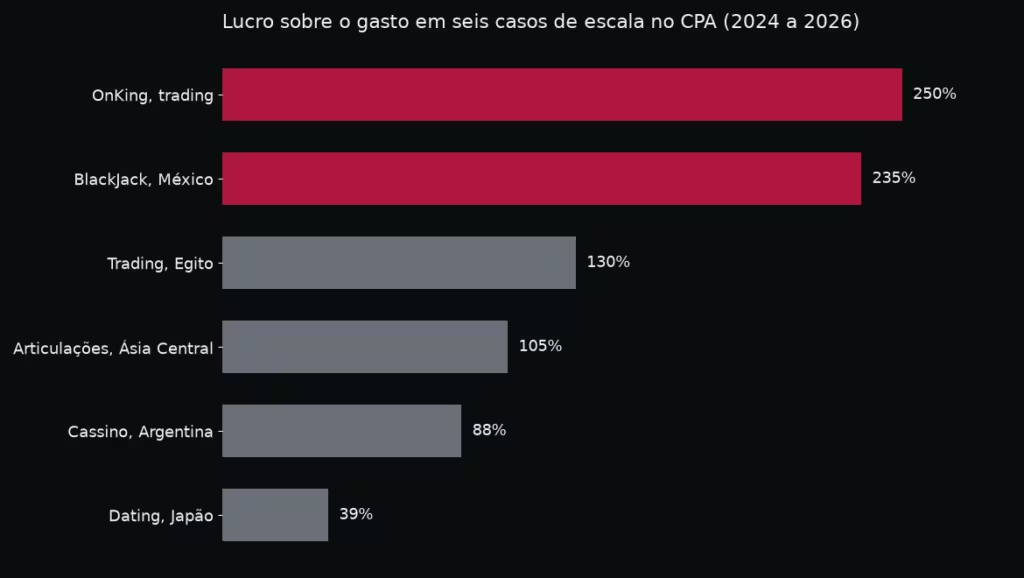
In none of these cases did the scaling come from swapping the offer. All of them changed the format, the creative, the country, or the team’s structure, with the offer that was already paying.
- In Egypt, the test closed with 1,200 sign-ups and 250 deposits, and the affiliate only raised the budget after the profit held for weeks, with several sources leading to Telegram
- Shopee went from 200 to 2,000 conversions a day with new formats, pages, and creatives, without touching the $1 per install
- In Mexico, 912 deposits came from a PWA on TikTok and local creative; the case lost close to $3,000 to bots before turning on the fraud filter, and still closed in profit
- In Argentina, 2,099 deposits came in 4 weeks with in-app ads and the bid climbing in steps
- OnKing scaled with a team of separate roles, and Japan with a zone whitelist
- In Europe, the OMNI CPA affiliate scaled by duplicating the paying campaign into other accounts, with leads between $4 and $5, and deleted the account that didn’t take off after $20 in spend
The mistakes that break a CPA campaign at scale
At scale, a mistake costs 10 times what it costs in testing, and it almost always shows up the same way. The cost per lead climbs with the offer unchanged.
- Bot traffic: the Mexico case lost close to $3,000 before filtering, and a pre-lander with a mini-game is the cheap filter
- A budget jump: doubling all at once wipes the algorithm’s learning and doubles the cost per lead
- A closed cap: the extra traffic becomes rejected leads and the approval rate collapses
- A long hold with short cash: scaling without cash for 30 days of waiting stalls the campaign midway
- A stale creative: 3 days of climbing clicks already call for a new piece
- Too many sources and scripts at once: OnKing capped it at 3 sources to keep control
A test on an app network spent more than $500,000 in 3 weeks and closed at a loss, according to CPA Lenta, in 2026. The volume climbed before the tracking, and big uncontrolled spend exists too.
- Check in the
postback(the automatic conversion notice) that every lead arrives with theSubID(the source tag). Without the tag, scaling raises the wrong ad’s budget - The cut rule exists before the first increase. Shut off the ad set whose cost per lead passes the ceiling before spending half the new budget
The checklist before doubling the budget
The whole scaling fits in a few checks, and the order matters. Run them in order, write down each item’s result, and only raise the budget when all of them close on the same day.
- Check the test’s profit with the clean approval, and go back to testing if it sits below 20%
- Check the volume: at least 10 leads a day for 3 days
- Tell the manager about the new volume and confirm the cap
- Write the cut rule at the lead’s ceiling and the 20%-a-day raise rule
- Duplicate the winning ad set with the same settings
- Prepare 2 fresh creatives before the cost per click climbs
- Set cash aside for the hold, because scaling multiplies the money sitting idle
- Raise 20% to 30% a day and double only with leads at half the ceiling
- Ask for the bump once the volume and the approval hold steady
Before blaming the scaling
When the cost climbs at scale, look at what changed that day before cutting the budget.
- The cap or the approval changed on the network’s dashboard
- The ad’s frequency passed 2
- The tracking broke, and the leads exist without showing in the report
- Competition entered the auction, and the cost per click climbed for everyone
If 2 of these failures show up together, the campaign goes back to testing. One alone gets solved without touching the budget.
CPA campaign scaling FAQ
When is a CPA campaign ready to scale?
When the test’s profit passes 20% with at least 10 leads a day and the approval rate holds. With less than that, a bigger budget only buys a bigger loss (Cpagram, 2024).
How much should I raise the budget per day?
Between 20% and 30% a day is the pace that keeps the algorithm steady. Doubling only happens when the cost per lead sits well below the ceiling, and a bigger jump blows up the cost per lead (CPA Lenta, 2024).
What is an automated rule?
It’s an instruction in the ad manager that acts on its own. It raises the budget when the cost per result is low and shuts the ad set off when it passes the ceiling.
Is duplicating the ad set worth it?
It is, with the same settings and in another account or campaign. The copy inherits what worked and spreads out the risk of a ban.
When do I swap the creative while scaling?
When the cost per click climbs for 3 straight days or the frequency passes 2. The audience got tired of the ad, and the offer is still the same.
What is a payout bump?
It’s when the network raises the payout per action for whoever delivers volume with quality. The common step sits between 15% and 20%, and a new account rarely gets one (Cpagram, 2025).
Does scaling mean going to another country?
Often. The same campaign moves to the neighboring country, and a second-tier country converted better than the rich ones in a multi-country test (Cpagram, 2025).
What breaks a campaign at scale?
Bot traffic, a cap closed without notice, a long hold with short cash, and a creative that never changes. Each one shows up as the cost per lead climbing with no explanation.
Do I need a team to scale?
Up to a certain volume, no. When the account, creative, and analysis work outgrows one person, a team with separate roles scales faster.
How much profit should I expect after scaling?
Less than in testing, and that’s normal. At scale, the test’s 60% profit lands near 30% and still pays, because the volume makes up for the thinner margin (Cpagram, 2024).
How to scale a CPA campaign: the bottom line
Scaling is raising what already pays, with a written rule and cash for the hold. The test closes with stable profit, and the scaling aims at double that, with the budget climbing bit by bit.
- Duplicate the ad set and the account with the same settings
- Swap the creative after every 3 days of expensive clicks
- Take the campaign to the neighboring country and to the new source in a small test
- Ask for the bump with the approval and the volume in hand
The other guides in this series cover choosing the offer and how CPA works. The ActionPay review shows a network read line by line.
In Mexico, $29,000 in spend became $40,540 in profit with the creative swapped every 2 weeks.
How we sourced this post
The numbers come from public offers and case reports in the niche, checked in August 2026. Each offer’s terms come from the networks’ own materials.
Commission, hold, and approval rates change without notice, and the catalog turns over every week. Check the offer in the dashboard before putting money on media.
Our fact-checking process is on the About CPA RAW page, and the other guides in this series follow the same method.
Spotted an outdated number? Let us know through the contact page.
This post is informational and not financial advice. Media buying carries risk: you pay for the traffic before you know whether it converts.
Leave a Comment